
The 2014-2016 water drop

In 2014-2016, something strange happened to the world’s water: a massive amount of it disappeared from the land, and did not return.
NASA scientist Matthew Rodell and colleauges figured this out using the help of some remarkable instruments. Two satellites with the name GRACE, flying in formation about 220 kilometers apart to meausure gravitational shifts. As the two satellites chase each other around the planet, tiny variations in Earth’s gravitational pull cause the distance between them to shift by as little as a micron, a fraction of the width of a human hair. And it is in those almost impossibly small changes that the story of the world’s water is written.
The principle of its operation its based on the concept that water has mass, and mass has gravity. When a region holds more water, whether in a swollen aquifer, a flooded plain, or saturated soil, it becomes fractionally heavier, and its gravitational pull increases ever so slightly. The lead satellite feels that extra tug first, pulling it ahead. By measuring the changing gap between the two spacecraft with extraordinary precision, scientists can essentially weigh entire regions of the Earth from space.
The resolution is about 300 square kilometers, meaning GRACE can’t tell you about a single lake or river, but it can tell you, with striking accuracy, whether a of about 300 square kilometer is gaining or losing water. Rodell’s team used this tool to find that between 2014 and 2016, land water dropped by the equivalent of 22 millimeters spread across the entire planet. Nearly a decade later, the water still hasn’t returned.
Their paper on this was called “An Abrupt Decline in Global Terrestrial Water Storage and Its Relationship with Sea Level Change. Here is the graph of their data. TWS is the total continental terrestrial water storage.
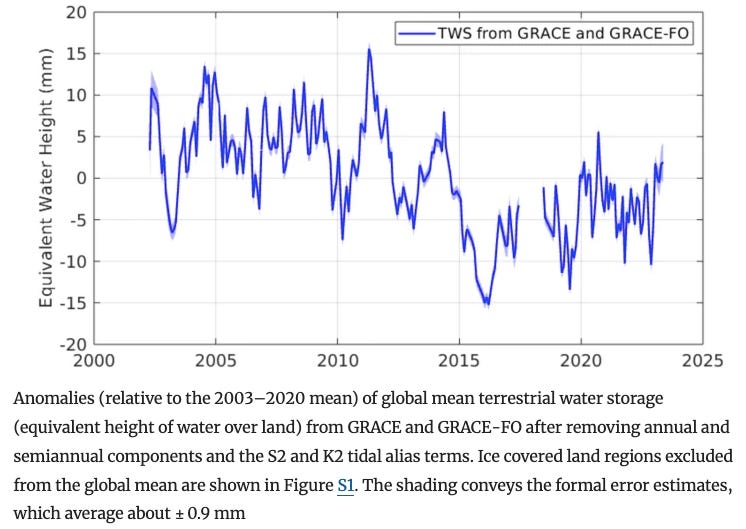
We usually think of droughts as local events, but the 2014-2016 crisis showed they can spread like a disease. It started with a record-setting drought in northeastern South America, which on its own would have been a manageable blip. But it happened during a period of extreme climatic instability, and the dryness didn’t just sit there. It cascaded across Africa, then Australia, then the Northern Hemisphere. By the end, 52% of the world’s land had hit record-low water levels, all at the same time.
Did this happen in the past? Well we are not sure as we only got the GRACE satellites in the early 2000s, and there’s no equivalent record before that. It’s possible the planet has experienced sudden losses like this in the past. But if it had, you’d expect the water to return once the rains picked up again. That’s what makes 2014-2016 different: the rains did return, in many places heavier than before, and the water still didn’t come back.
One reason for the sudden loss seems to be heat. A warmer atmosphere acts like a thirstier sponge, pulling more water back into the air before it can sink into the ground. Even when rain returned to drought-hit regions, it evaporated before it could recharge underground reserves. On top of that, we’ve cleared forests and paved over wetlands that used to hold water in the soil. Without them, the land has lost its ability to save water. The result is a new reality where the Earth’s water supply is running at a permanent deficit, and the old rules of recovery no longer apply.
But as we try to understand why the water isn’t coming back, our own water systems come under scrutiny. And here, a concept from network science offers an insight: explosive percolation.
In network theory, percolation describes how a system becomes connected. Normally this happens gradually, new links form one by one, and the network grows slowly. But under certain conditions, something different happens. The connections build quietly beneath the surface, and then all at once, the whole system snaps into a single giant network in one sudden jump. This is explosive percolation, and it has a troubling mirror in the way we manage water
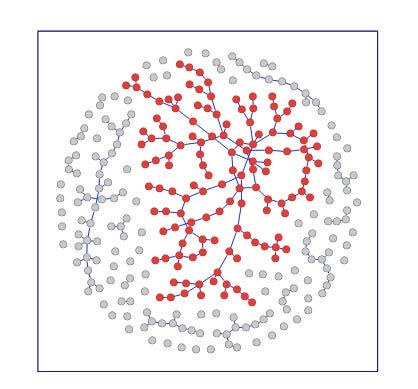
As we’ve built more dams, pipelines, and irrigation systems, we’ve quietly been stitching the world’s water sources together. On the surface, this looks like good management: a more integrated system should be more resilient, more efficient, more controllable. But integration has a hidden cost. The more connected the nodes become, the more a failure in one place spreads to all the others. We have been, without quite realizing it, engineering the conditions for explosive percolation in our water systems.
Historically, water was stored across a vast, decentralized network, countless lakes of all sizes, wetlands, and underground aquifers spread across the landscape. If one failed, the others could compensate. A drought in one region would draw down local reserves, but the damage would be contained. The system had natural firebreaks. Iran’s ancient qanat system is a good example of how this once worked. Qanats are networks of gently sloping underground channels, some thousands of years old, that carry groundwater from mountain aquifers down to villages and farms across the desert. Because the water travels underground, it loses almost nothing to evaporation. And because the system is spread across thousands of small, independent channels rather than stored in one place, a failure in one part of the network has little effect on the rest.
We’ve been replacing that kind of network with something far more fragile: large centralized reservoirs. Iran itself made this switch over the past several decades, building large modern dams in place of its qanats. The result was a significant increase in water lost to evaporation, as vast open surfaces of reservoir water bake under the Middle Eastern sun. What the qanat kept cool and hidden underground, the reservoir exposes to the sky. This is the decentralization versus centralization problem in its clearest form: a thousand small, protected stores versus one large, exposed one.
Think of it like the difference between keeping your savings spread across many small community banks versus putting everything into one giant vault. If the small banks have a bad year, you still have most of your money. But if the giant vault gets overwhelmed, you lose everything at once.
This leads to an interesting hypothesis: could centralization, and the explosive percolation it enables, be partly responsible for the scale of the 2014-2016 drop and the failure to recover? In a decentralized system, water losses would have been absorbed gradually across thousands of smaller stores. But with so much water concentrated in large reservoirs, and those reservoirs increasingly connected to one another, a synchronized drought could drain the system far faster than before, crossing a threshold suddenly rather than declining gradually. And when the rains return, reservoir operators are often forced to release the water straight back to the ocean to prevent flooding, rather than letting it slowly percolate back into the ground. The land never gets the chance to refill.
The connections run deeper still. When we pump aquifers heavily for irrigation and urban use, we lower the water table, and rivers that once relied on their own local groundwater begin competing for baseflow from the same diminishing underground reserves. Problems cascade quickly across what once seemed like separate systems. And evaporation itself isn’t the enemy. In the Amazon, water that evaporates cycles back as rain and keeps the whole system alive. The problem is when water isn’t given the chance to sink slowly into the ground and return to the atmosphere on its own terms. That slow, patient cycling is what keeps water supplies healthy over time.
Some practitioners have been pointing toward a different path. Zach Weiss and Brock Dolman are among those who have been advocating for the decentralization of water. Their work focuses on slowing water down and spreading it across the landscape rather than channeling it into large central stores. The idea is to restore the land’s natural ability to absorb and hold water, through techniques like rebuilding wetlands, restoring floodplains, creating small ponds, and working with the contours of the land to keep rain where it falls for as long as possible. It is, in essence, an attempt to rebuild the thousands of small nodes that the old system once had, and that we’ve spent the last century dismantling.
Is the GRACE satellites measuring not just a climate problem, but also a water engineering one? The very act of trying to manage water more efficiently, connecting it, consolidating it, controlling it, may have made the whole system more brittle. Like a network on the edge of explosive percolation, it held together quietly for decades, and then in 2014, it snapped. The work of people like Weiss and Dolman suggests that the answer may not be better central management, but less of it. We haven’t just changed the climate. We’ve changed the plumbing. A centralized pipe, it turns out, is makes for easier for the large sudden loss of water.
For another example of decentralized water management check out: Rajendra Singh’s organization Tarun Bharat Sangh (https://tarunbharatsangh.in/know/) they have been doing this work for fifty years. It is one of the most inspiring organizations as they not only work with very poor farmers but the majority of the employees come from the villages where the work is done. Their work in Rajasthan led to Rajendra Singh winning the Stockholm Water Prize. Rajendra is also one of Zach Weiss’s mentors. Long story short, decentralized water management works and TBS has decades of proof.
Thank you for this, Alpha. It echoes the situation with ecosystems. Diverse ecosystems are resilient against insects because if one species is under attack, others still grow. Yet reduce the ecosystem to monocrop agriculture and a single insects can wipe out entire crops.