


My dad, Shui Yin Lo, was a particle physicist at University of Melbourne who came to the US to an invention. He later got involved with studying water, and became a visiting professor of physics at Caltech.
He found this very curious phenomena with water. When he put salts into the water and then diluted them out, at a high dilution these micron sized solid-like water clusters would form. These nano structures float inside the liquid water. If you then evaporate all the liquid water you are left with these small solid-like water structures. He gave these structures the name IE crystals and also stable water clusters. These structures have many important implications for many fields beyond water.
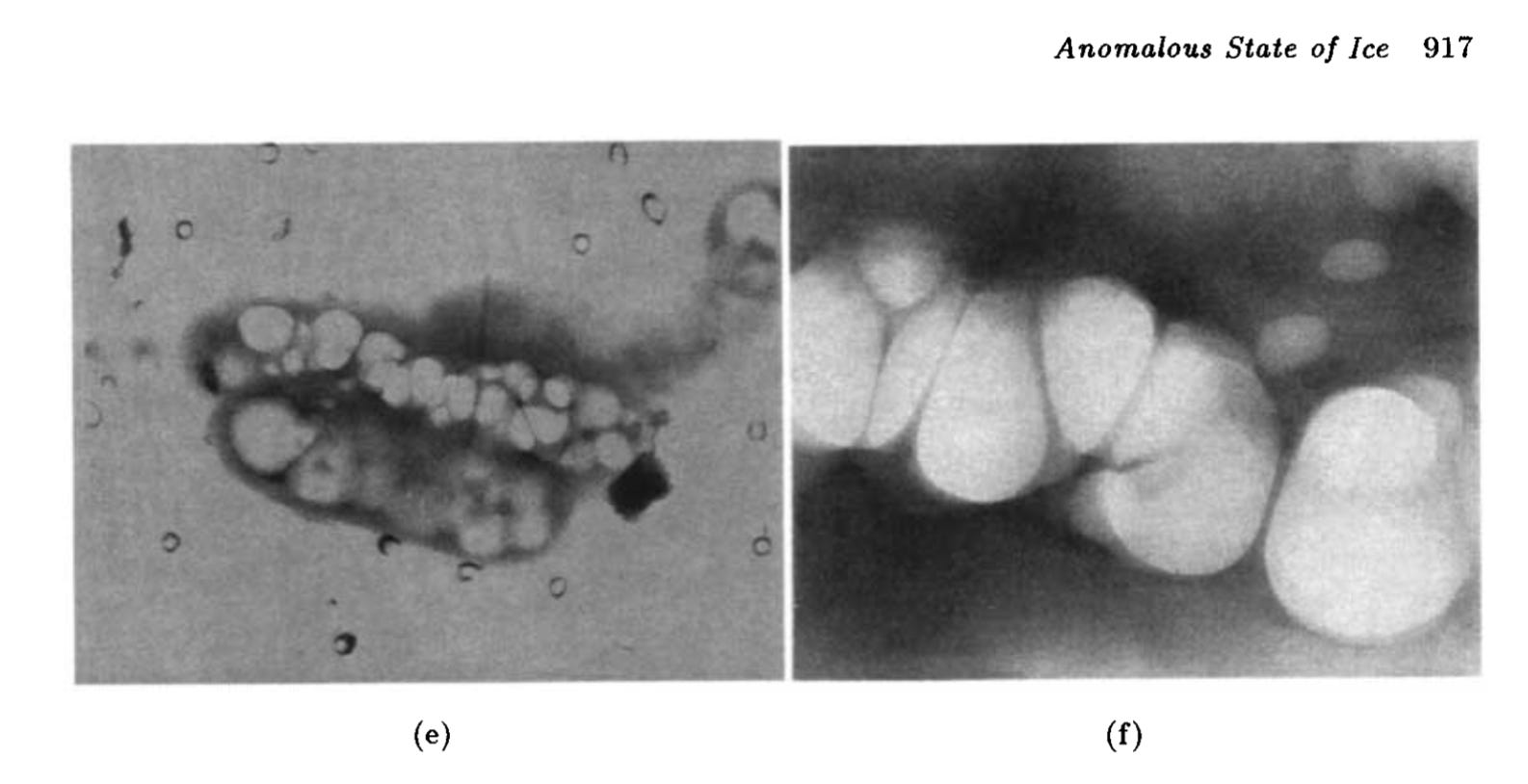
[nano structure water pictures, from this paper Lo, Shui-Yin. “Anomalous state of ice.” Modern Physics Letters B 10, no. 19 (1996): 909-919.]
He published these results in a mainstream physics journal with the title “Evidence for the existence of stable-water-clusters at room temperature and normal pressure”.
It goes on in paper ‘We report the finding of isolated stable-water-clusters of tens of nanometers to micron size from the evaporation of very dilute sodium chloride solution at room temperature and normal atmospheric pressure. The stable-water-clusters are found to be electrically charged by examination via an Electric Force Microscope (EFM). Raman scattering and infrared spectrum of residues from the evaporation show similar but not identical characteristics of liquid water.
One of the greatest advances on our understanding of water comes from the study of water-clusters. Most water-cluster studies have been focused on smaller water-clusters, below 100 water molecules. There exists a few studies on stable-water-clusters from tens of nanometers to micron size. These water-clusters are reported to be stable at room temperature at normal atmospheric pressures. These clusters are reported to be created from very dilute solutions made from a variety of different materials.
Here we report further evidence of these stable-water-clusters created from diluting minute amounts of NaCl in ultra-pure water.
In dilute solution of NaCl, sodium and chlorine ions coexist with water molecules, which have permanent electric dipole moment. The electric interactions of the dilute solution consist of those among ions and dipoles. When the density of ions is high, the dominant interactions are those among ions. As the concentration of NaCl decreases, there are less and less ions per unit volume. The interaction among ions becomes less and less. The interaction among dipoles becomes more and more important. There comes a point when the dipole–dipole interactions dominate. The transition point when this occurs is found experimentally to be at the concentration about 10−4 M(mol/liter). At concentration below this transition point, water molecules will attract to one another to form clusters that have permanent electric dipole moment, much like small magnets stick together to form a big magnet.”
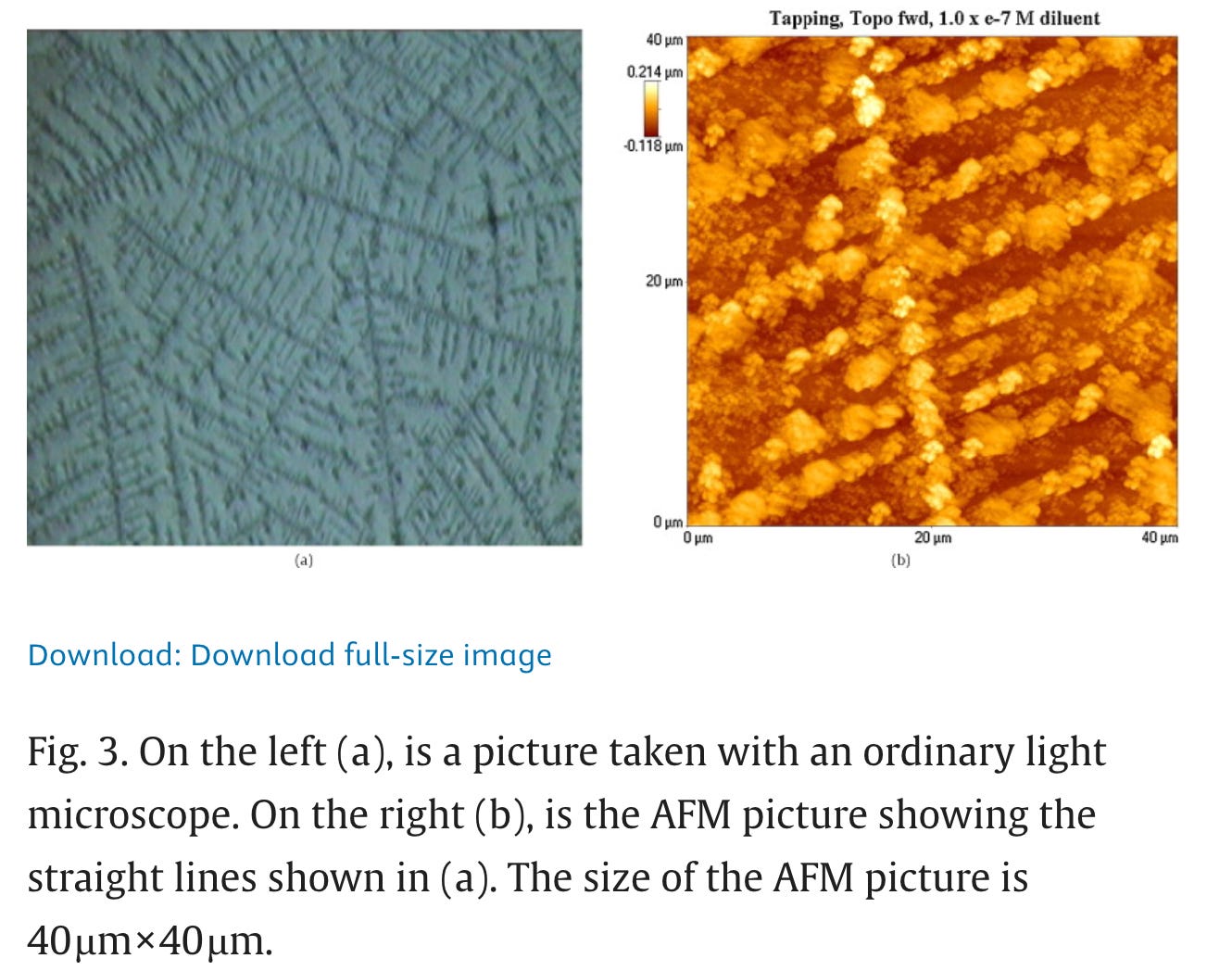
More pictures of the water structures:
I wanted to record a podcast with my dad but was a bit hesistant. Someone suggested I could do it with a more limited distribution by putting it behind a paywall, so that’s what I did here with the podcast.
Listen to this episode with a 7-day free trial
Subscribe to Climate Water Project to listen to this post and get 7 days of free access to the full post archives.


