
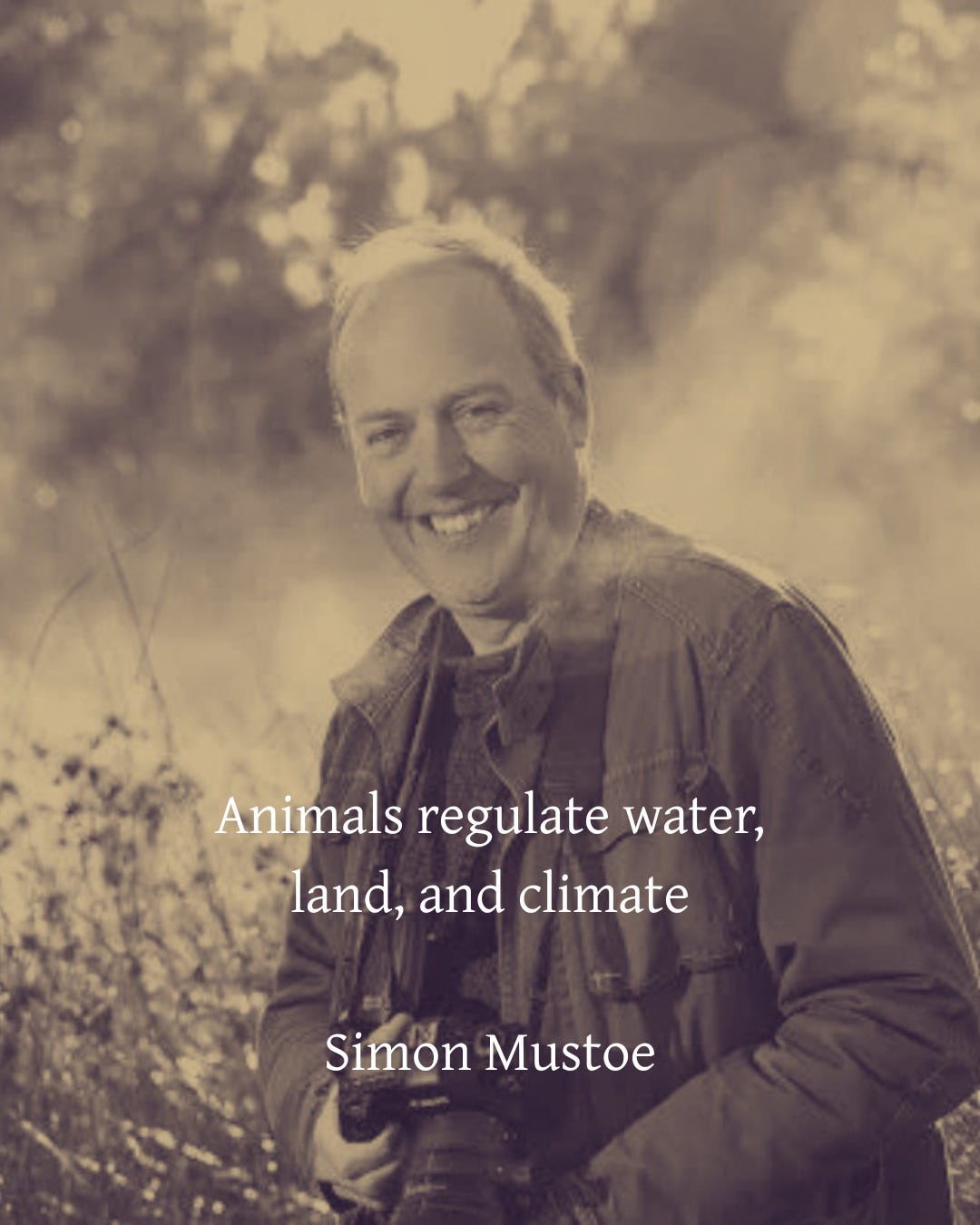
I was excited to finally be able to interview Simon Mustoe after three years our initial effort. I think he presents a very important perspective of importance of animals to land, water and climate.
There is traditional, simplistic view often held, that says climate sets the stage for the water cycle, the water cycle sets the stage for vegetation, and vegetation sets the stage for animals. In recent decades there has been a perspectival shift and enlargening, in that much more work on how vegetation also affects the water cycle and climate in turn. Simon Mustoe has been putting forward yet a further perspectival shift and enlargening, and that is that animals are the key regulators of vegetation, the water cycle, and climate itself. I really like his ability to frame this shift and emphasize its importance. He has also been putting these ideas into action, as he goes into different bioregions facilitating the community to self-empower themselves into doing ecological restoration.
Integrating vegetation’s evolving impact on climate was already a difficult step for climate models over the last two decades, since vegetation grows leaves and roots, multiplies, and dies back, adding significant complexity. If animals are so important, it seems to me, climate models won’t be truly accurate until animals are integrated as well, and that raises the complexity further still, since it would mean modeling how animals move, reproduce, and engage in a wide range of behaviors, something current climate models do not attempt. I had previously discussed Daisyworld, the original toy model simulation proposed by James Lovelock, where black and white daisies would help regulate the temperature of a toy planet. If the planet got colder, more black daisies would grow, and their heat absorption would heat up planet. If the planet got warmer, more white daisies would grow. The planet hence self-regulated its own climate via vegetation. Researchers then added more complexity to the planet - they added different colors of daisies, they put in rabbits which ate the daisies, and they added in foxes which ate the rabbits. With more biodiversity it might seem that there would be more fluctuations in the temperature of the planet. But most curiously, in many of the simulations, the extra biodiversity and larger trophic network actually caused the planet to self regulate its climate even better.
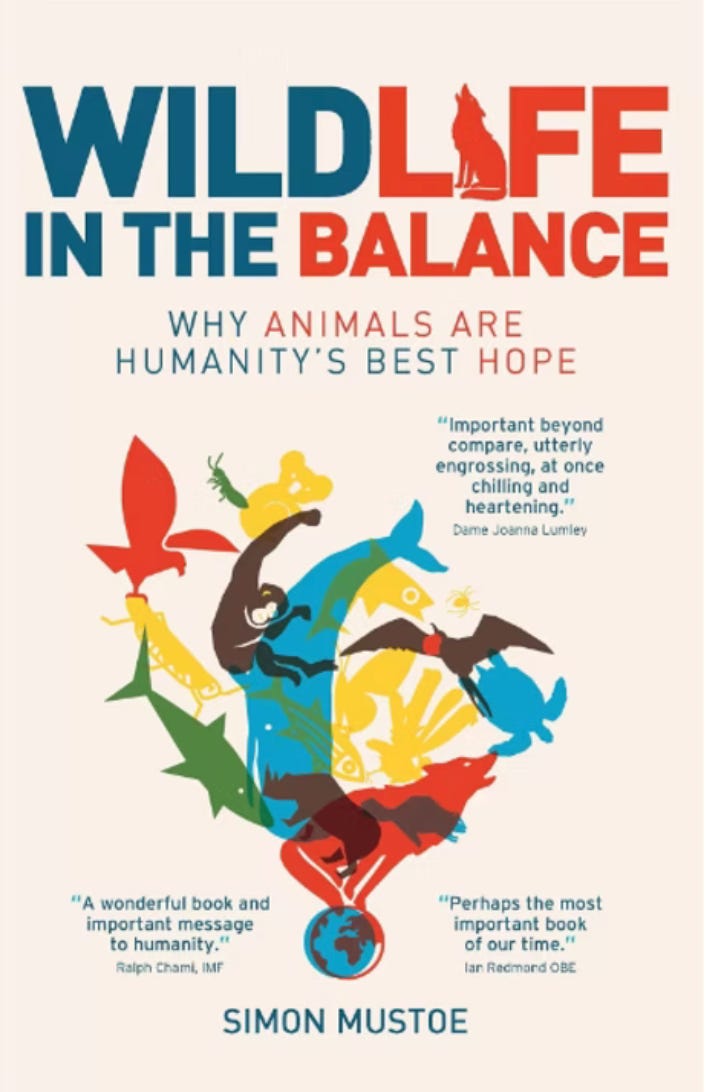
Simon Mustoe argues in his book Wildlife in the Balance that animals, not just plants or physical processes, are the essential engineers of a habitable Earth. He makes the case that humanity's survival now depends on shifting our relationship with wildlife from one of domination to one of cooperation, treating conservation not as a moral extra but as a practical necessity. Despite the scale of our crisis, the book is quite hopeful, it frames restoration as achievable and even fast-acting rather than a lost cause, e.g. beaver reintroduction in Norfolk producing measurable flood reduction within five years.
Plants turn sunlight into stored chemical energy. Animals distribute and restructure that energy across landscapes. Plants help convert the energy input. Animals regulate how that energy concentrates, cycles, and amplifies. The animals are key to understanding the thermodynamics of the planet, and how energy and order emerge.
Reading his book three years helped clarify for me the animal regulatory perspective on ecology and climate. Our conversation presented here, stimulated more thought. After our interview he sent me an essay where he further elaborated on the role of animals to the water cycle.
In the essay he described how water covers most of the planet, yet the water which actually sustains life is remarkably scarce. Surface freshwater, the rivers, lakes and wetlands people depend on, makes up only a sliver of a percent of Earth’s total water. The rest is saltwater, locked in ice, or buried underground in ancient reserves that barely renew. Mustoe argues that keeping this small share usable and available has never really been a matter of rainfall or geology alone. It has been the work of animals.
He traces this back to Earth’s fortunate place in the solar system and its magnetic, iron-rich core, conditions that allowed water to stay on the surface rather than boil away or never form at all. But Mustoe distinguishes between water simply being present and water being available for life. Water becomes unavailable, he says, when it arrives as extreme weather, turns polluted, fails to soak into soil, evaporates too fast, doesn’t linger long enough in lakes and reservoirs, or rushes back to the sea before it can be used. Making water usable in that deeper sense, he contends, is something animals have done gradually, over an immense stretch of time, by building the ecosystems that regulate it.
Mustoe says it took roughly thirty million years of continuous evolution for these ecosystems to reach a stable, self-supporting state, one where the maintenance of water and climate became tightly bound to the needs of living things. Human civilization, in his account, arrived only recently, inheriting a water cycle that animals had already spent millions of years calibrating. He acknowledges this can sound like a chicken-and-egg question, but resolves it in favor of animals: water existed before life, but the water cycle relied on today exists because of life.
Mustoe lays out several ways animal behavior shapes water availability. Burrowing and soil-disturbing species, from bandicoots in Australia to beavers in England, help prevent flooding by giving water somewhere to soak into the ground rather than run off and overwhelm rivers and towns. The same processes work in reverse during dry periods, he explains, as animals that loosen and aerate soil create a kind of sponge that holds moisture underground for longer, easing the risk and severity of drought. He extends this even to the ocean, arguing that blue whales, by feeding and moving through different thermal layers, help regulate sea temperature in ways that influence rainfall on nearby continents.
He also argues animals filter water indirectly, by sustaining the plant diversity that keeps rivers and forest systems clean. Mustoe cites the clear blackwater rivers of Bornean rainforest, shaped in part by orangutans, in contrast to the polluted waterways near palm oil plantations where animal life has been displaced. Healthy, biodiverse catchments upstream of cities like Melbourne and Kathmandu supply cleaner water, he says, precisely because the animals within them maintain nutrient cycles that keep pollution and disease in check.
That same biodiversity, Mustoe notes, reduces the need for pesticides. When ecosystems lose their animal diversity, a small number of opportunistic species tend to dominate and become what people call pests, prompting chemical control that eventually pollutes waterways. Maintaining even modest levels of predator and prey diversity keeps that imbalance from occurring in the first place, he argues. He extends the pattern to the atmosphere itself, noting that seabird colonies are among the largest natural sources of ammonia on Earth, a substance that combines with ocean-surface compounds to seed clouds and influence rainfall across entire continents.
Below is part of our conversation (edited and abridged)
Alpha: We’re going to talk about animals and ecology and why animals are so important, and why animals are so crucial for the water cycle. What do you say is the importance of animals to everything? How would you frame it?
Simon: There are effectively three things that enable life on Earth for animals like us. We depend on food, water, and shelter.
None of those three things can exist without animals. Planet Earth has ecosystems, and we can be distracted by vast structures like forests or reefs (reefs are slightly different because reefs are made of animals), but if we look at forests generally, because we’re land-living animals, we tend to have this understanding or impression that, say, a mountain and the effects of the weather on that mountain, or that forests, are actually the givers of life, that there is really only the supporting infrastructure.
We live in a very thin, thin layer on top of that. It’s a very fragile layer, and the only reason why life exists at all, and how we could evolve first, was because animals collectively created, from those initial ingredients, the manner in which we could tweak it, exist, and subsequently survive.
There’s actually a quote that I’m going to give you, which came from an Aboriginal guide at a place called Budj Bim, a World Heritage Site in Western Victoria that few people know about, but as important as the pyramids of Egypt and Machu Picchu. It’s a living culture that still exists after 65,000 years and looks after a large area of land. One of the guys, when I went there, said to me, “The animals are here to look after the land. We are here to look after the animals.” We’re there to look after the animals, to effectively look after the partners in the environment that we maintain the environment alongside, and without which we can’t actually do it properly. And in doing that, and just looking after the animals, the land looks after itself, or the animals look after the land.
Alpha: That’s really powerful. If we default to this idea that the basis of the conditions for animal life is the climate and the plants that they’re around and then also the water cycle, and those are the environment, and if you have those right, then the animals come. And you’re saying it actually is more bidirectional: the animals also impact the water cycle, impact the plants, impact the climate.
And then you add this other thing that the animals kind of help take care of us, but then you have this other thing also, that the humans are taking care of the animals, so it’s kind of like our role.
Simon: The climate is a consequence of animal behavior. It’s like we live in climate-conditioned houses. It’s about making it comfortable, safe, and secure for our survival, right? Climate, planetary-wise, is exactly the same concept.
Now, things are confused these days by the fact that we’ve broken those systems, and we kind of feel like we have, at one point, some control over the systems, another point no control. But if you go back way back in time, everything that created the climate today was built upon the evolution of animals and ecosystem structures. So, as you know, I’m a big advocate for looking at this from a sort of energetic perspective. Without getting too deep into that, energy flows around the planet, and when that energy is absorbed into the thin layer of land and sea, effectively that enables our lives, because we’re just very much on the surface, literally. More of that energy that is absorbed into those living systems is what enables soil to be productive, which, in turn, soil comes from damp soil, comes from climate.
Our ability to find food, any animal’s ability to find food, whether it be a fisherman leaving today to go out across into the Atlantic off the west coast of the east coast of America to go fishing, or whether it’s a seabird that’s taking off from Manic Island in the remote band of sea, searching for fish to eat. We all have the same basic need to know where things occur, and where they occur is a consequence of the climate. But the climate is a consequence of the actions of those animals in the past, because the more energy that’s in that system, the less there is flying around surplus around the planet to upset the balance, there’s less uncertainty there is, and the more things modulate and they slow down, and eventually they reach what we call a steady, stable state, where we can be more often than not confident that we know, for example, that if we want to get a particular type of food to grow on a field, that we can do it at this time of year, and that we’re gonna have a period of sunshine followed by a period of rain, and then that we’re going to be able to harvest.
Whereas, as we are fully aware these days, systems have broken down; they’ve been disrupted to the extent that they’ve become uncertain, and now farming is very difficult to do. And animals are finding the same thing. To reverse that process and go back to where we were before requires rebuilding the functionality of those systems, and that requires animals.
Alpha: So you have stated a very powerful thesis that animals create the conditions and help, the soil, the food, the plants, the climate. And as I read more of your book, I was like, whoa, this is really a really useful perspective, and it really shines a light on things that you don’t normally think about, like the whole other role for animals, and it was really powerful for me to kind of see it. Do you—I was wondering—could we actually now rewind a little bit and just kind of talk a little bit about how you came to this thesis, your background and your, you know, yeah, how you came to be an ecologist and how you ended up with this kind of perhaps a little bit maverick viewpoint?
Mustoe: So first of all, it’s interesting you say it’s a maverick viewpoint. I think actually today it’s not so much a maverick viewpoint. I think the emerging narrative is very much on this side; it’s just taking a while for it to kind of filter through.
But look, I go back to my time at university. I mean, so a lot of things never sat very comfortably with me, and there’s a particular moment in Australia, a few years after I arrived here in the early 2000s, when I did a presentation to a group about short-tailed shearwaters, which is one of the most abundant seabirds on Earth. It used to be.
And what I’d always been curious about is why are we not conserving these incredibly abundant animals, which clearly are having an enormous impact on the environment? So I spent quite a few weeks researching short-tailed shearwaters to try and sort of work out the scale, intensity, and degree of their impact on planetary processes, and then flipped the script a little bit in the talk and said, “Well, okay, so if they’re producing this amount of ammonia, this amount of nitrogen, they’re doing this over this distance and this spatial area, and so on, they must be having a profound impact on our planet.”
And I converted a whole room full of people from, at the start of the presentation, I said, “Should short-tailed shearwaters be a conservation priority? There’s this number of tens of millions of them, blah, blah, blah,” and pretty much hardly any hand went up in the room. By the end of the presentation, everyone put their hand up and was like, “No, this is—they’ve got to be really important.”
And I remember asking some PhD students there at the time. I said, I said, “So, question, open question. I said, why are you doing your PhD, say, on humpback whales?”
Why? And they’re like—and they couldn’t answer the question. I was like, “So, have you ever considered this question? Like, so if somebody turns around to you and says, ‘I don’t give a damn about humpback whales or short-tailed shearwaters or any animal. If they disappear, it makes no difference to my life whatsoever, does it? Can you persuade them otherwise?’”
And that’s been the kind of pivot point. And so honestly, Alpha, I reckon it took me another 12 years to answer that question. It just—it dominated my thinking for so long.
Alpha: Are you working as a wildlife consultant, or what were you doing when you gave this talk and what were you doing in those 12 years?
Simon: Yeah, so I’ve worked in various numerous fields, but for much of my life I’ve been a consultant. So I’ve worked for almost every manner of client you can imagine, from heavy industry through to non-governmental organizations at the local and international scale. My work has always been vested in sort of conservation or out trying to create outcomes, which is always very difficult on the kind of industrial side.
And that’s the other dimension, I suppose. I was increasingly bothered by the fact that when I began as a consultant in the sort of early ’90s, I was doing work in the UK. I remember doing a water vole project with a guy called Dr. David Hill. And we were creating habitat for these animals, and I thought that was rather remarkable. And it was almost a no-brainer that you would do that. And over the subsequent years, that kind of became not so much a thing. It was almost like we spent most of our time writing reports that wrote the animals out of the story. It was like, “Oh, this thing isn’t particularly significant, and therefore this development can go ahead.” And that was done not because I believed it, but because there were statutory sort of set-and-forget guidelines or rules. And so the ecology and the whole wisdom of the whole thing sort of was taken away.
And so you’re left with an emptiness, really, of going, “Well, what—why am I doing this? And what difference does it make?” I mean, I truly believe these animals are important, other people clearly do, but there are many people who don’t.
And I don’t understand that. And so that whole—this is what sort of led me to revisiting almost my entire learning of ecology and ecosystems and relearning it from the ground up, and becoming what I would say now is more of an ecosystem specialist, which is to look at the systems-based side of things rather than looking at sort of individual problems. You look at the background and the whole system that surrounds that before you actually make decisions, and then it reveals some extraordinary things that you can do, opportunities as well.
Alpha: So your training in university was as an ecologist, and then after that you became a wildlife consultant.
Simon: Yeah, yeah. And there’s a certain approach, paradigm, like where you focus more on one species and try to save it, as opposed to this kind of ecosystem viewpoint that you’re now positing.
Yeah, well, you can still focus on an individual species, but there’s still an ecosystem basis to it. And, you know, increasingly the species that we should be focusing on, to a large degree, are people, right? And this won’t sit well with some of your listeners. And I always get pushback: “Why should this be about people?”
Well, there’s a couple of really important reasons. One, people are the biggest, most dominant animal in the system. And the moment we separate people and animals as different entities, we fail.
Okay, so you have to consider people as animals, and our behavior is very animalistic as well. And we are therefore the changes, the drivers of change. And with the drivers of change, in both a good and a bad way, we can be positive and negative. There’s another dimension to that, that at an individual level, a lot of our impacts are negative, but at a group level, positive. So there’s this kind of weird dichotomy that happens in ecosystems where, at an individual level, we struggle to make decisions that destroy the environment around us, but as a group and collective whole, some of the losses that we occur as individuals become gains for others, not just humans but other animal life. And the overall outcome of that can actually be stable and positive.
Alpha: In your book The Wildlife in the Balance, the thesis is that the important role that animals play.
Simon: Yeah, and as the subtitle says, Why Animals Are Humanity’s Best Hopes. But literally, I want to pull the lid off any idea that we have any future unless we allow wild animal populations to rebuild around us.
Alpha: The importance of the animals to the water balance…
Simon: Okay, so when I was researching the second book, I’ve been working with a guy called Nigel Sharp from the Ojanasa Foundation, just near Melbourne, and there’s a really lovely story about an animal called an Eastern Barred Bandicoot. So they’re only—they’re about so big, you know, and they have—they’re a little pointy-nose thing. If you’re in the UK, they look a bit like a Womble, tiny ears, little stripes down the side. And they were thought extinct on mainland Australia until about the late 1980s.
And a guy called John Wamsley, who was a big advocate for conservation and quite a divisive character, set up at the time a predator-proof sanctuary to house the remainder of these animals that they had found unexpectedly living in abandoned cars in a quarry in Western Victoria. So there was probably only a couple of dozen of them left, right?
So they brought them into the sanctuary and protected them. Now, Wamsley’s vision was very advanced. He was thinking about people investing in nature, the sort of things we’re actually really doing now these days, but it was too early, and his company unfortunately went under. But Nigel Sharp, a wealthy philanthropist, decided to buy it out and, in the early ’90s, took over.
And I visited the Rockwell Sanctuary in the early 2000s, about 2004, not long after it had been taken over by Sharp. And at the time, there were lots of Eastern Barred Bandicoots there.
I went back about three or four years ago, and the change in the environment was remarkable. I could see that. But more had happened because Sharp, meanwhile, had partnered on an area of land, which is farming land, a sheep farm near Tiverton in Western Victoria, with a guy called Harry Youngman. And they fenced that sheep farm and they introduced these Barred Bandicoots.
So this is a species that literally almost went extinct. And in fewer than a few years, they recreated the soil organic structure to such a degree that the sheep’s wool tensile strength increased and increased and increased the profitability of the farm.
Now, the other consequences of that—and the other sanctuary—are that, and obviously this is all connected with water, right? Because Eastern Barred Bandicoots are burrowing animals, they also dig in the ground, so they create all these furrows and pits. And there were two immediate consequences, the very rapid consequences: water settles in those places and it doesn’t run away; it goes down holes and whatever.
And within a few years, what they found was where previously they’d had to rebuild fences almost annually to accommodate floods, the fences now—and during this time they had some of the most extreme floods ever recorded—their fences held fast simply because of the improved soil structure created by the bandicoots.
Now, to put that into some perspective, one flood in Queensland last year cost $80 million in fence reconstruction, okay, over the Queensland state. Now, the other thing it does is, I mean, flooding nationally in Australia costs the state—the cost to society—$4.5 billion. The Insurance Council of Australia predicted that will escalate to $50 billion a year by 2050. We’re currently spending $5.4 billion a year on weed and pest management. Weed and pest management has almost disappeared at these sanctuaries because of the actions of the animals.
Again, they’re building a structure. So the weeds, which are used to sort of going over large areas that are very uniform, are now having to find their spots in all these furrows and ridges. So it’s advantaging a more diverse vegetation type, which brings with it more insect life. It means carbon increases.
And some of the latest work shows that reintroducing predators, even spiders, like wolf spiders, or recreating their habitat to enable wolf spiders to exist in a grassland, can increase carbon uptake in the soil by—I’m gonna ask you to guess. How much do you think carbon uptake has been shown to increase just by allowing spiders and invertebrates to recolonize?
Alpha: I don’t know, 0.5% carbon?
Simon: 50 times. So this deals with carbon and water immediately. Yeah, so we’ve talked about, obviously, talked about the water consequence. And so these things are all embedded and mixed together. It’s hard to kind of separate one from the other.
So there’s a guy called Professor Oswald Schmitz at Yale University, lovely individual, an amazing researcher, and he tells a really interesting story about his background because he started his work wanting to study the bison on the large plains in North America, and he said that there is no space left for that. Everyone—all the big megafauna—have been taken, and he was forced down into the ground amongst the spiders and insects, okay.
And in hindsight, couldn’t have been a better thing to happen. Because he said, of course, you can manipulate those things in the environment, you can manipulate spiders and see what happens.
They did a study where they removed the predatory spiders from the landscape. So I’m not talking about the web-building spiders, yeah, but I’m talking about things like wolf spiders and jumping spiders, the things that actually are like the lions of grassland, okay. They removed them and something really interesting happened, and they saw a 50-times reduction in the carbon in the grassland, and they’re scratching their heads going, “I don’t know why this. How does that work?”
Because we kind of understand that ecosystems are regulated from the top down throughout, I might point out, not just from the top, but all the way down. There’s this pressure downwards, downwards, downwards to the environment that holds all this infrastructure together.
So later they worked out that what was happening is this. It’s really interesting because you’re gonna understand the parallels with humanity in a moment. So it all hinges around grasshoppers. So grasshoppers are really abundant animals in grasslands, and they’re a main resource for spiders.
Okay. So in the absence of spiders, what happened was the grasshoppers would be enabled to move further. Now, normally, humans, animals, or whoever, if you’re given—for example, if I lay a table full of food out in front of you, including eggs and a bit of meat and vegetables and salad, and where they’re—you’re exquisitely capable of picking almost the precise mix of protein and carbohydrate to enable your existence. It turns out all animals do it equally the same. Some degrees of variation in the quantities and proportions, but all animal life does this, right?
But in the absence of predators, the grasshoppers could look over there and they could see, “Oh, there’s a nice juicy, sweet plant over there, like a 7-Eleven slushy coming down the road towards me.” I—you know what I mean? You like humans—we’ve removed this instinct, and we do the same thing.
So the grasshoppers started moving through the landscape. They started eating more carbohydrate-rich food because it was now available, and the consequence of that was when they died, the proteins in their body were of a different variety, and the soil microbes could not assimilate that into the soil, and so there was a 50-times reduction.
Introduce spiders back into the environment, and the grasshoppers are then forced to choose from the plate of food in front of them, and they don’t move very far, which means they stay where they are, and the consequence of that is they eat a more balanced diet, and that means that when they die, their bodies can be metabolized far more effectively by the microbes in the soil.
Now, human beings are kind of the same. Whilst we don’t have predators so much—I mean, we do in some parts of the world—we do like to do sports, and sports triggers a similar kind of reaction in our body, our sort of fight-or-flight mechanisms and so on.
And so when we balance our health and our environment around us with the foods that we produce and the nutrients that provide us, we become part of that change as well. So, once again, there’s a very significant link between human behavior, human psychology, human mental health, human physical health, food, soil production, water cycles, and if you can get that right, all you have to do really is recreate or maintain a healthy ecosystem around where you live, and everything else just emerges from that. Right.
Alpha: So it’s kind of like you have to think very non-linearly, right? Because you have to think spiders affecting the grasshoppers, which affects the fruit, which affects the digestion, which affects the soil, and then the soil carbon then affects how much the water cycle. So, how do ecologists look at—I mean, there’s so many non-linear factors. How do you know which animals to include in your analysis, which are not, and yeah, how do you know which ones you should introduce?
Simon: Well, the answer is you include all of them. And so that’s a really interesting question. So I would—I’m gonna get into trouble for saying this, but globally, I would say ecologists have got a lot of this wrong. Okay, there’s increasingly too much reductionism in ecology.
So we reduce systems into their parts to try and understand the whole. And that won’t work, okay. It’s not the right approach.
Let me give you an example. If you want to protect seagrass, you would fence it off from all turtles, and then the seagrass would grow faster. Dugongs, whatever, get rid of them. Okay, seagrass goes faster, result. Now, no one in their right mind would ever say that we should exclude turtles and dugongs from the seagrass system. In fact, we know full well that grass comes back stronger if it’s allowed to be grazed. We know that across the board.
And it’s the same with all life, right? So you have to look at the whole system, and there are other issues with dugongs, tiger sharks coming in, predating at certain times of the year, which pushes the dugongs away and allows the grass to come back, and that’s seasonal, and that’s to do with climate, and so on and so on.
So what you have to do instead is you have to look—you have to model the whole system, and you have to understand how that functions first, and that part is actually missing globally right now, but we are currently working on that. And then, once you’ve had that systemic understanding, you can then start to make decisions on what matters to protect so that the system enhances itself.
The alternative way of doing things, which is where you manage the animals, where you try and pick an animal and focus on that, is the opposite of what you need to do. Okay, you need to look after the system. You need to look after all the animals that hold that system together. And then the land will look after itself.
Alpha: And do the ecologists have to introduce, like, the bandicoots or the spiders, or do they—or what do you— is it all you just do nothing, or, like, do you have to do a little nudge at the beginning?
Simon: It all depends. And this is the thing, it’s very much site-specific. And there’s a whole other dimension to this, which is the human dimension.
You know, there’s certainly a certain amount of money that can be applied in certain places. There are the values that we hold dear that enable us to live in this system, which are also shared by the other animals.
There’s a whole heap of different conditions. There’s a lot of work at the moment being done on nature finance, and one of the things they’re stressing about is how do they understand the socio-ecological context of individual places to secure and reduce risk for investors in those places? And that, again, can be done, but only on a systematic level.
So the question, in a way, is not what animals should we protect, or what action should we take. It’s first: can we understand our place within the system, and can we guide the community at large to understand that and therefore make wiser decisions for themselves about what to do and where?
Alpha: So let’s say you are hired to consult. Like, there’s a lot of places in the world right now that need their water cycle—you know, in Spain, for instance, where it’s drying up, or in Australia, which has lots of issues. So if you were hired as a wildlife consultant to go in, how would you determine which animal you might want to be reintroduced to help?
Simon: Well, first of all, it’s the wrong, completely the wrong question. And it’s the mistake most conservationists make. So if you go in with a preconception on what you think needs to be done because you’re an expert, you are completely and utterly on the wrong path to begin with. It’s not your job, and you don’t have the evidence for that.
Nobody has, right? So the first thing you have to do, and we’re doing this right now, we’re actually producing a project right now, which I think is probably globally groundbreaking. We’ll have the results in the next few months, where we have built a systematic model of the entire socio-ecological system from the ground up, and we have integrated—we’ve done that alongside and co-designed it with the local community.
So, in saying, like, California, the first thing you would do is you would go out and canvas inputs from a vast cross-section of the local community, and that doesn’t have to be a large number of people, just a big cross-section, okay, that encompasses lots of different interests and needs and values, right? And not just groups of people, not just represented by conservation groups, but everybody from all walks of life.
And that’s what we’ve just done here very successfully in Victoria. And you build out of that, you connect their values and their needs back through the ecosystem to the features that most matter to them, even though they didn’t know it to begin with.
I’ve ask them: what percentage of your personal productivity, or your productivity, work and play, do you think is dependent upon having access to those healthy places that give you that need?
And so far, it’s averaging over 60%. So, in other words, more than 60% of what we need and value as human beings that makes us productive, not just in our work life but in life in general, that underpins our entire economic productivity, is coming from the aspects of nature that we connect with that are not tangible necessarily. It can’t be measured in direct monetary terms, but nonetheless, it’s incredibly powerful and important.
Now, once you understand that, if you go back to those three questions, if we formalize those questions into a model with hundreds of people, and we can link the things that they’re interested in.
So, give you an example. A snorkeler particularly loves seeing seahorses. We know seahorses are within seagrass in these places, which means we can now say that that snorkeler’s values depend upon these specific locations being healthy.
Now, as we do that across the whole of the community, and we use a standardized framework for this, we can actually turn around to the government—we’re about to do this in Victoria—and we can produce an action plan and say, if you take actions in these specific places, not only are you increasing the functionality of the whole ecosystem systematically, and systematically and on a systems basis, lifting the whole lot up, but you are having maximum benefit to all of these shared values that all of these people have, because a lot of those values flow differently.
So, you know, seagrass isn’t just good for snorkelers seeing seahorses, it’s also good for fish of this, and it’s good for these people for this. And there’s a whole heap of interconnected things.
It’s a very complex model, but we have that model now, and what we can do then is we can have an evidence base. That point is the point at which we would say, okay, you don’t say, “What animal should we protect?” You go in: these are the systems that we need to protect to maintain the community value, our economic productivity, and the health of the ecosystem in one.
What’s missing? What structural parts of those systems are not functioning properly because of, say, the absence of an animal? And then you might reintroduce it, or an animal that’s struggling because of pressure, so you would try and remove those pressures.
So the evidence that presents from understanding the system reveals the animals to protect. You don’t go in at the beginning and say, “These are the animals I think we should protect.”
And one of the probably fundamental problems we have with ecology in the world at the moment is experts coming out over the top of the community, extolling the virtues of their idea, which may be a wonderful idea. I’m not suggesting that, but without first evaluating whether, in fact, it matters and where it matters.
And when you do that, it empowers entire communities for change, it transforms people’s thinking about their connection, it restores all these various functions, including water cycles and soil cycles, it improves your mental health, makes people happier, and it gives us purpose, which is probably the most important thing.
You have purpose that’s shared between researchers and community working together, rather than people, as I say, coming in over the top and sort of making their recommendations about what they think should be done when really they don’t have the evidence to make those recommendations in the first place.
…..
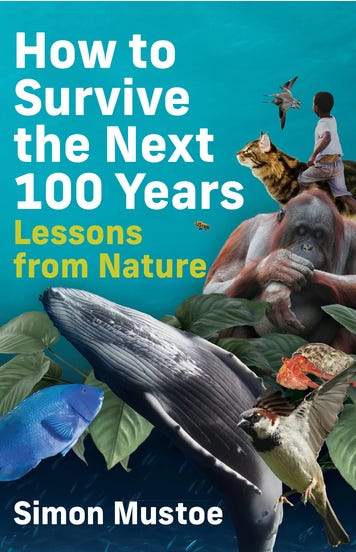
For more info see Simon Mustoe’s blog https://simonmustoe.blog/ . He also has a second book out “How to survive the next 100 years - lessons from nature”